
Ardem Items, Resources and Crafting
Last verified 20 August 2026 against the official Steam store page and playardem.com.
Ardem crafting runs on salvaged components rather than raw ore. You dismantle the world — furniture, fences, wrecks, appliances — into nails, planks, scrap metal, wire and cloth, then combine them into tools, base parts, vehicle parts and electrical equipment. Cooking, farming, medical items and clothing all sit in the same crafting economy.
Ardem's crafting economy is a salvage economy. There is no mining loop feeding a smelter; there is a world full of man-made objects and a set of tools for taking them apart. Understanding that inverts how you look at every building you enter.
Item categories in Ardem
| Category | Examples | What it feeds |
|---|---|---|
| Components | Nails, scrap metal, wire, planks, cloth | Base building, vehicle repair, tool crafting |
| Tools | Hammers, axes, prying and cutting tools | Gate salvage itself — no tool, no components |
| Vehicle parts | Engine and body components, modules, attachments | Vehicle repair and upgrades |
| Electrical | Generators, solar panels, wind turbines, wiring | The electricity system |
| Food and drink | Scavenged tins, crops, hunted meat, fish, water | Hunger and thirst |
| Medical | Bandages and treatment items | Injury recovery |
| Wearables | Clothing, footwear, headwear, bags, armour | Temperature simulation and carry capacity |
| Weapons | Firearms, melee, explosives | Combat and defence |
The salvage loop
Almost every early component in Ardem comes out of something that already exists. Wooden fencing, pallets, shelving and cheap furniture yield nails and planks. Fridges, washing machines, ovens and derelict vehicles yield scrap metal. Curtains, bedding and clothing yield cloth. The gate is not the location — it is whether you are carrying the right tool.
That has a practical consequence most new players miss: carry a tool before you go looting. Walking into a rich building without a hammer or prying tool means walking out with a fraction of what was there.
Clothing is equipment, not cosmetics
Techtive Games confirms a dynamic temperature and clothing system that simulates weather realistically. That makes wearables a functional item category: what you have on determines whether rain and cold are an inconvenience or a death sentence. Bags matter for the same reason inventory always matters in salvage games — carry capacity is the real limiter on how productive a run can be.
Character personalisation covers appearance, gear and playstyle, so there is a cosmetic layer too. It sits on top of the functional one rather than replacing it.
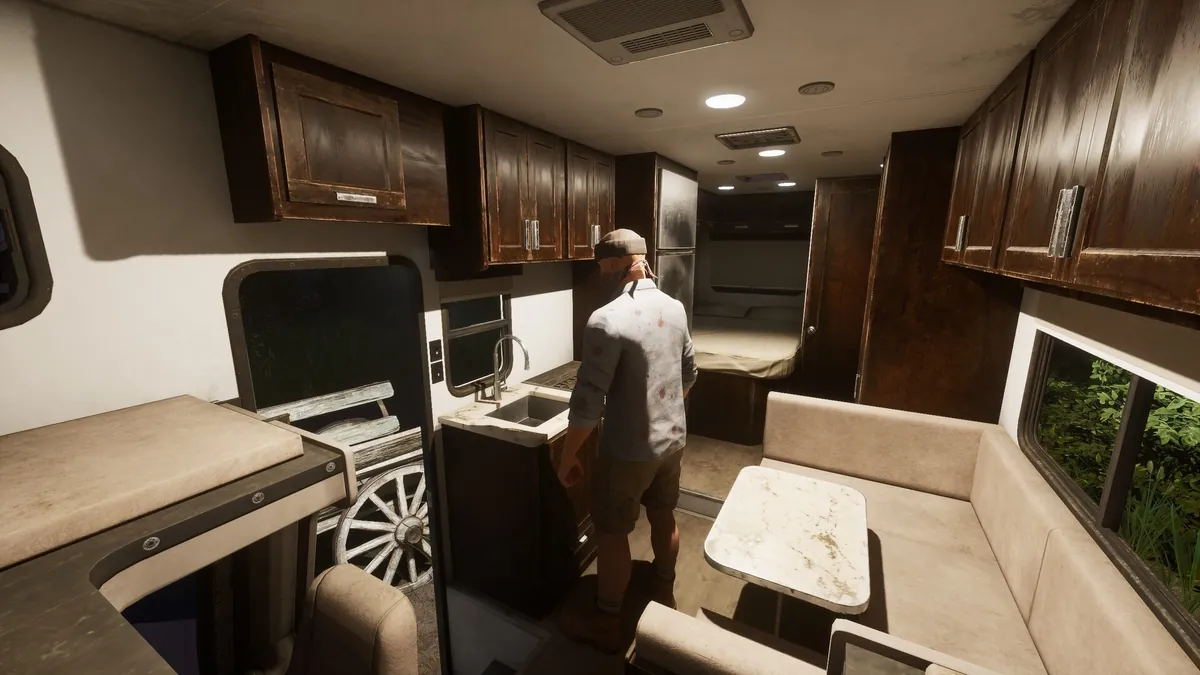
Food, cooking and the switch to production
Scavenged food is finite. Ardem gives you three confirmed permanent sources — crop growing, hunting wildlife and fishing — and farming tools are part of the base building system rather than a separate mechanic. Cooking recipes turn raw ingredients into something worth eating, and a fire solves warmth and water treatment at the same time.
The transition from looting tins to producing food is the moment an Ardem run stops being fragile. Guide: farming, hunting and fishing.
Is crafting gated by skills?
Not currently. Techtive Games lists a skill system as a long-term goal in the official Steam FAQ, which means Early Access crafting is gated by materials, tools and knowledge rather than by character levels. In practice that is friendlier to new players and to co-op groups, because nobody has to grind a class before they can contribute.
What this page deliberately does not claim
No official Ardem item database, recipe list or stat table has been published. Every category above is derived from confirmed systems and official material; none of the exact craft costs, stack sizes or durability values are stated here, because they are not public and would change anyway. This page becomes a real per-item database during the 15 October 2026 public playtest. See the editorial policy.
Character creation and appearance
Character Customization is an official Steam tag for Ardem, and Techtive Games describes personalising your appearance, gear and playstyle. So there is a character creation step, and it sits alongside the wearables system rather than replacing it: how your survivor looks is partly creation-time choice and partly what you are currently wearing.
What has not been published is the depth — whether Ardem offers preset bodies and faces or a full slider-based editor, and whether appearance is per-character or per-account. Since worlds are server-hosted and persistent, a per-server character is the more likely arrangement, but that is inference rather than a confirmed detail. It gets verified during the October public playtest.
Key takeaways
- Ardem's crafting is a salvage economy — you dismantle the world rather than mining raw ore.
- Nails and scrap metal are the two components that gate most early progress.
- Clothing is equipment, not cosmetics: it feeds directly into the temperature simulation.
- Farming, hunting and fishing are the three confirmed permanent food sources.
- A skill system is a long-term goal, so Early Access crafting is gated by materials and tools, not levels.
Frequently asked questions
Do you mine ore in Ardem?
Salvage is the primary loop. Most metal in the early game comes from dismantling man-made objects rather than mining.
Is there a crafting skill tree in Ardem?
Not yet. Techtive Games lists a skill system as a long-term goal in the official Steam FAQ, so Early Access crafting is gated by materials and tools rather than character levels.
Is there an item weight limit in Ardem?
Carry capacity is clearly a constraint — bags are a confirmed wearable category and salvage logistics dominate play — but Techtive Games has not published the numbers behind it.
Do items degrade over time in Ardem?
Not confirmed. Food spoilage and equipment wear are genre standards and Ardem has cooking and farming systems, but no degradation mechanic has been officially described.